
Book chapter
Polymer Supported Hydroxide
Electronic Encylopaedia of Reagents for Organic Synthesis · 2003 · Electronic · E1–E2
Abstract not currently available.
Research record
Search the archive and use research tags to move between publications and the group’s scientific programme.
54 publications found for Immobilised reagents and scavengers
Book chapter
Electronic Encylopaedia of Reagents for Organic Synthesis · 2003 · Electronic · E1–E2
Abstract not currently available.
Book chapter
Polymeric Materials in Organic Synthesis and Catalysis · 2003 · Chapter 2 · 53–136
Abstract not currently available.

Journal article
Synlett · 2002 · (5) · 775–777
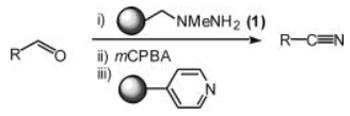
A polymer-supported hydrazine reagent has been applied to the conversion of a range of aldehydes to nitriles, providing a clean and efficient route to more diverse building blocks for combinatorial chemistry programmes.

Journal article
J. Chem. Soc. Perkin Trans. 1 · 2002 · 16 · 1850–1857
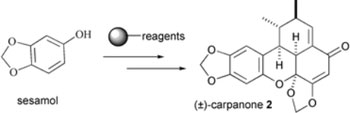
Polymer-supported reagents have been applied to the synthesis of the natural product carpanone resulting in a clean and efficient synthesis without the requirement for conventional purification techniques. A new polymer-supported transition metal isomerisati…
Journal article
Synlett · 2002 · (3) · 516–518
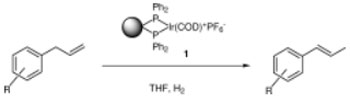
A polymer-supported iridium catalyst has been prepared and used in the isomerisation of the double bonds in aryl allylic derivatives with excellent trans selectivity and without the need for conventional work-up procedures.
Journal article
Synlett · 2002 · (10) · 1641–1644
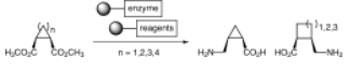
Polymer-supported pig liver esterase was used for the resolution of meso-diesters. The enzyme can be recovered quantitatively from the reaction mixture by filtration and reused without significant loss of activity. Further transformation of the resulting enan…

Journal article
Nat. Rev. Drug Discovery · 2002 · 1 · 573–586
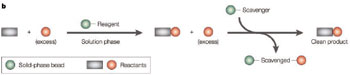
The increasing need to efficiently assemble small molecules as potential modulators of therapeutic targets that are emerging from genomics and proteomics is driving the development of novel technologies for small-molecule synthesis. Here, we describe some of …

Journal article
Chem. Rec. · 2002 · 2 · 377–388
This article is based on a lecture presented to the Chemical Society of Japan at Wasada University on March 27, 2002, by Professor Steven V. Ley. The lecture, “Organic Synthesis in a Changing World,” was a comprehensive account of the ongoing research efforts…

Journal article
Farmaco · 2002 · 57 · 321–330
Since the early days of combinatorial chemistry solid-phase organic synthesis has been the method of choice for the production of large libraries. Solution-phase synthesis is again gaining importance especially for the synthesis of parallel arrays of smaller,…
Journal article
J. Chem. Soc. Perkin Trans. 1 · 2002 · NA · 143–154
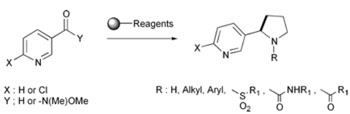
The sequential use of solid-supported reagents and scavengers has led to an efficient synthesis of the natural products nornicotine 1, nicotine 2 and further fuctionalised derivatives. Also reported is a diastereoselective route to both enantiomers of nicotin…
Journal article
Comb. Chem. & High Throughput Screening · 2002 · 5 · 197–199
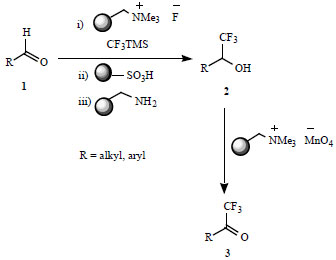
A two step synthesis of trifluoromethyl ketones from aldehydes is reported. A combination of polymer-supported reagents and sequestering agents were employed to effect the transformation without the need for chromatographic purification.

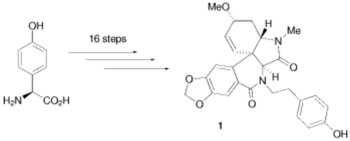
Journal article
Angew. Chem. Int. Ed. · 2002 · 41 · 2194–2197
A sequence of polymer-supported reagents and scavengers was used to promote the synthetic transformations in the first total synthesis of (+)-plicamine (1), a member of the amaryllidaceae alkaloid family, starting from L-4-hydroxyphenylglycine.