
Research record

Publications

Search the archive and use research tags to move between publications and the group’s scientific programme.

201 publications found

Cover of J. Chem. Soc. Perkin Trans. 1
Graphical abstract for Molybdenum(0) and tungsten(0) catalysts with enhanced reactivity for allylic substitution: regioselectivity and solvent effects.

Journal article

Molybdenum(0) and tungsten(0) catalysts with enhanced reactivity for allylic substitution: regioselectivity and solvent effects.

Malkov, A. V.; Baxendale, I. R.; Mansfield, D. J.; Kocovsky, P.

J. Chem. Soc. Perkin Trans. 1 · 2001 · (10) · 1234–1240

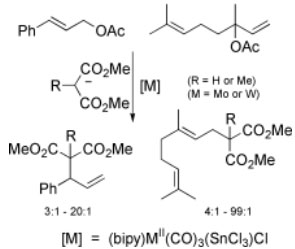
The binuclear Mo(II) and W(II) complexes 28a,b and 29a,b have been developed as pre-catalysts for allylic substitution with β-dicarbonyl nucleophiles. These complexes are reduced in situ to Mo(0) and W(0) catalytic species 30a,b and 31a,b by excess of NaH, em…

Cover of Organometallics
Graphical abstract for Synthesis of new chiral 2,2 '-bipyridyl-type ligands, their coordination to molybdenum(0), copper(II), and palladium(II), and application in asymmetric allylic substitution, allylic oxidation, and cyclopropanation.

Journal article

Synthesis of new chiral 2,2 '-bipyridyl-type ligands, their coordination to molybdenum(0), copper(II), and palladium(II), and application in asymmetric allylic substitution, allylic oxidation, and cyclopropanation.

Malkov, A. V.; Baxendale, I. R.; Bella, M.; Langer, V.; Fawcett, J.; Russell, D. R.; Mansfield, D. J.; Valko, M.; Kocovsky, P.

Organometallics · 2001 · 20 · 673–690

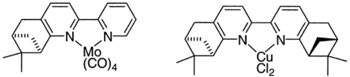
A series of chiral bipyridine-type ligands 5−12 has been synthesized via a de novo construction of the pyridine nucleus. The chiral moieties of the ligands originate from the monoterpene realm, namely, pinocarvone (13 → 6, 7, and 9), myrtenal (18 → 5), nopino…

Cover of J. Chem. Soc., Perkin Trans. 1
Graphical abstract for Multi-step organic synthesis using solid-supported reagents and scavengers: a new paradigm in chemical library generation

Journal article

Multi-step organic synthesis using solid-supported reagents and scavengers: a new paradigm in chemical library generation

Ley, S. V.; Baxendale, I. R.; Bream, R. N.; Jackson, P. S.; Leach, A. G.; Longbottom, D. A.; Nesi, M.; Scott, J. S.; Storer, R. Ian; Talyor, S. J.

J. Chem. Soc., Perkin Trans. 1 · 2000 · (23) · 3815–4196

The use of polymer-supported reagents and scavengers provides an attractive and practical method for the clean and efficient preparation of novel chemical libraries with potential application in the pharmaceutical or agrochemical industries. These methods…

Cover of Bioorg. Med. Chem. Lett.
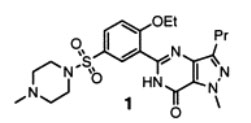
Graphical abstract for Polymer-Supported Reagents for Multi-Step Organic Synthesis: Application to the Synthesis of Sildenafil.

Journal article

Polymer-Supported Reagents for Multi-Step Organic Synthesis: Application to the Synthesis of Sildenafil.

Baxendale, I. R.; Ley, S. V.

Bioorg. Med. Chem. Lett. · 2000 · 10 · 1983–1986

Sildenafil 1 (Viagra™), a well known and commercially important pharmaceutical drug, has been prepared using polymer-supported reagents in a multi-step, convergent process resulting in a clean and efficient preparation without the need for conventional purifi…

Cover of Green Chem.
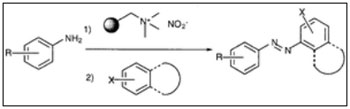
Graphical abstract for The Clean and Efficient Synthesis of Azo-Dyes Using Polymer-Supported Reagents.

Journal article

The Clean and Efficient Synthesis of Azo-Dyes Using Polymer-Supported Reagents.

Caldarelli, M.; Baxendale, I. R.; Ley, S. V.

Green Chem. · 2000 · 2 · 43–45

The recent technological advancements in polymer-supported reactions have led to the propagation of combinatorial chemistry as a method for the rapid and efficient preparation of novel functionalised molecules. An interesting and fast growing branch of this a…

Cover of J. Org. Chem.
Graphical abstract for Molybdenum(II)- and tungsten(II)-catalysed allylic substitution

Journal article

Molybdenum(II)- and tungsten(II)-catalysed allylic substitution

Malkov, A. V.; Baxendale, I. R.; Dvorak, D.; Mansfield, D. J.; Kocovsky, P.

J. Org. Chem. · 1999 · 64 · 2737–2750

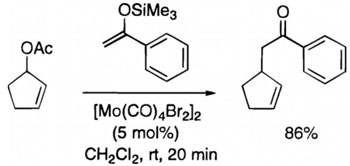
The molybdenum(II) complexes Mo(CO)5(OTf)2 (7a), [Mo(CO)4Br2]2 (8a), their tungsten(II) congeners 7b and 8b, and bimetallic complex Mo(CO)3(MeCN)2(SnCl3)Cl (9a) have been found to catalyze the C-C bond-forming allylic substitution with silyl enol ethers deriv…

Cover of J. Org. Chem.
Graphical abstract for Molybdenum(II)-catalysed allylation of electron rich aromatics and heteroaromatics

Journal article

Molybdenum(II)-catalysed allylation of electron rich aromatics and heteroaromatics

Davis, S. L.; Mitchell, W. C.; Malkov, A. V.; Baxendale, I. R.; Mansfield, D. J.; Kocovsky, P.

J. Org. Chem. · 1999 · 64 · 2751–2764

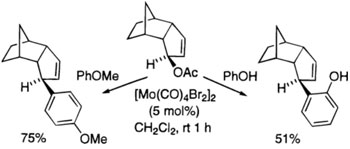
The stable, readily available molybdenum(II) complexes [Mo(CO)4Br2]2 (B) and Mo(CO)3(MeCN)2(SnCl3)Cl (C) have been found to catalyze C−C bond-forming allylic substitution with electron-rich aromatics (e.g., 15 + PhOMe → 62) and heteroaromatics (e.g., 15 + 36 …

Cover of Tetrahedron Lett.
Graphical abstract for Molybdenum(II)-catalysed allylic substitution

Journal article

Molybdenum(II)-catalysed allylic substitution

Malkov, A. V.; Baxendale, I. R.; Mansfield, D. J.; Kocovsky, P.

Tetrahedron Lett. · 1997 · 38 · 4895–4898

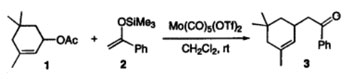
The new Mo(II) triflate complex 5 has been found to catalyze the C-C bond forming allylic substitution with silyl enol ethers derived from β-dicarbonyls (e.g., 6 + 12 → 14) and from simple ketones (e.g., 6 + 13 → 16) as nucleophiles.